Curiosity before capacity
Ask how SKU velocity, order shape and peak duration interact before selecting a headline throughput.

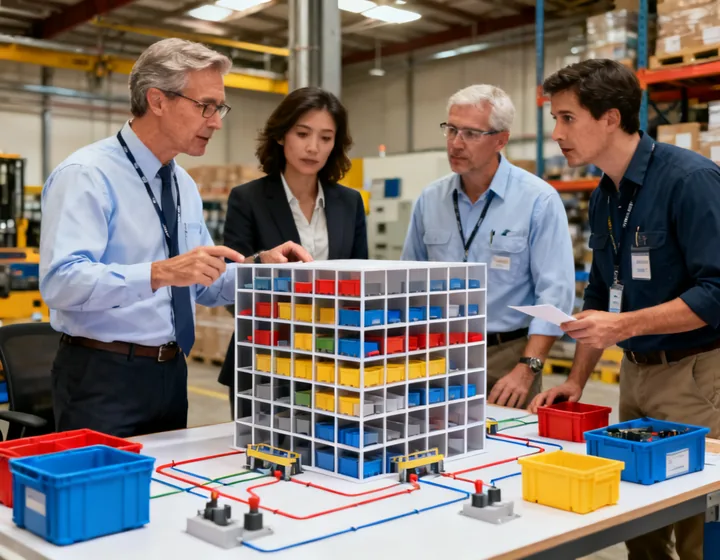
Our role is to keep the operating question in view while teams work through grid geometry, robots, ports, controls and commissioning.
AutoStore traces its planning perspective to 1967 in the supplied brand brief, but that generated-range date is not presented as an independently verified corporate claim. What matters to a current project is the working habit behind the story: observe the load, the order and the exception before recommending equipment.
That habit changes the first meeting. Instead of asking how many robots a site wants, the team asks which order families drive the peak, how replenishment competes for ports, what happens when an interface times out and which area must keep shipping during a brownfield cutover. Answers become explicit assumptions in the design record.
“A friendly advisor does not remove trade-offs. It gives every owner a shared way to see and test them.”
Planning ranges, simulations and acceptance tests are labeled by source and condition. Certification references remain separated from product-model evidence.
Operations, IT/OT, maintenance, EHS and procurement can review the same flow map without losing their accountability boundaries.
Ask how SKU velocity, order shape and peak duration interact before selecting a headline throughput.
Document WMS, WCS, PLC and equipment ownership while changes are still inexpensive.
Test fault handling, safe access and restart paths as seriously as the nominal production run.
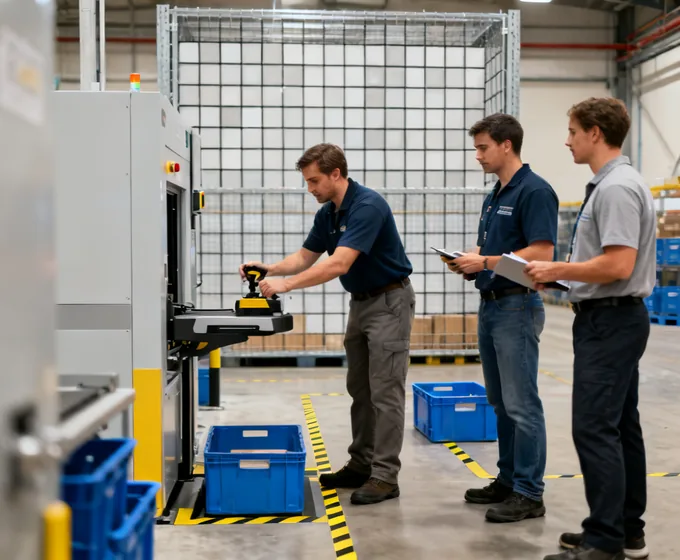
A commissioned system is not ready if alarms, isolation steps or degraded modes live only with the integrator. Role-based sessions connect operator response, maintenance intervention and controls escalation to the exact site workflow.
During a typical readiness exercise, the group walks through a blocked port, delayed WCS message and unavailable robot route. The process records who detects the condition, who may intervene, what evidence is retained and which rate is acceptable while the issue is contained. This is a practical scenario description, not a claim of a named customer outcome.
Limitations stay visible: simulation cannot reproduce every behavior of live inventory, training decays without drills, and a responsibility matrix must be maintained when software or staffing changes.
Bring operations, controls, maintenance and procurement to a structured discovery session. Leave with decisions, assumptions and evidence requests—not a generic equipment list.